

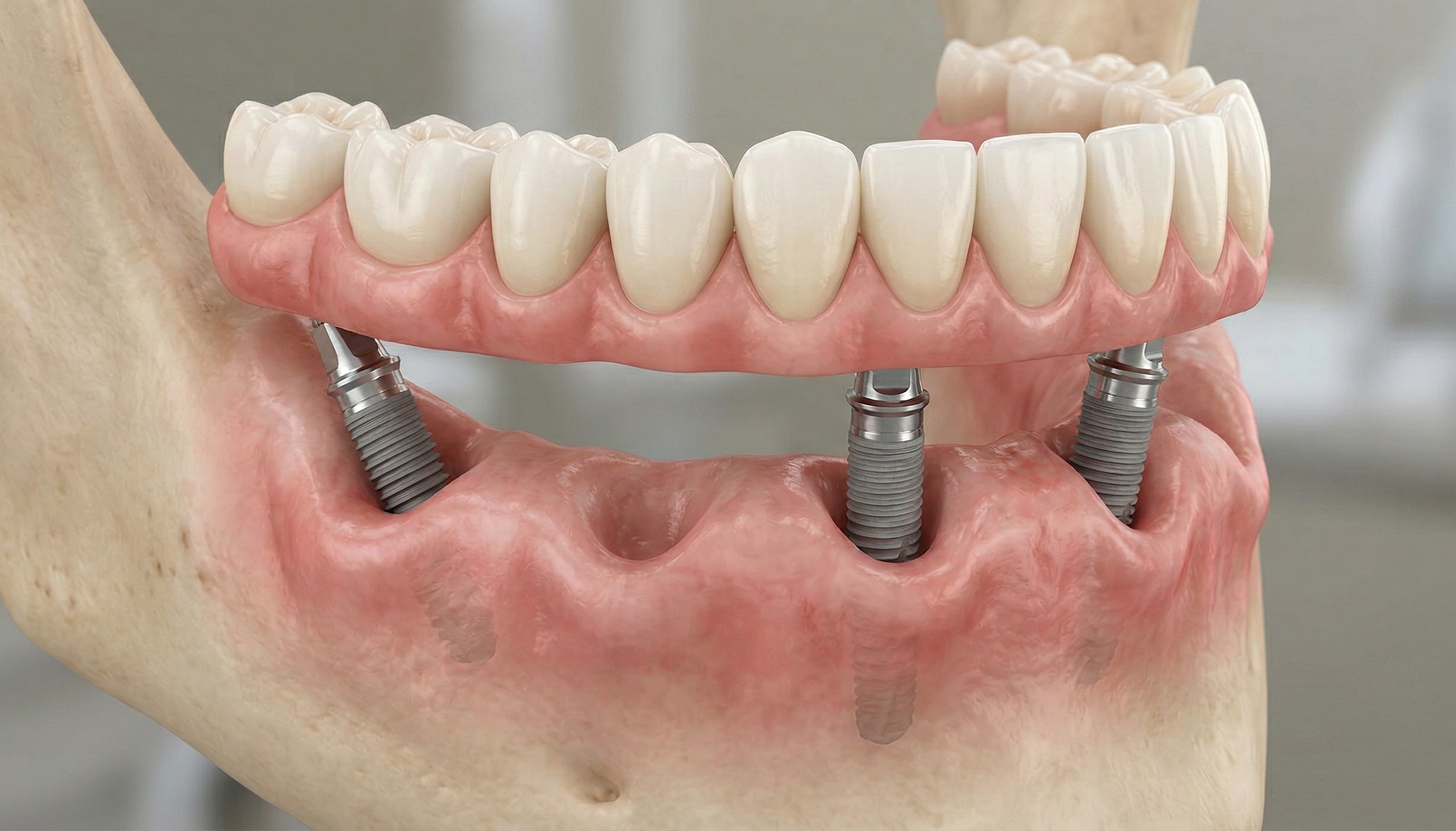

In contemporary implantology, the goal is to provide edentulous patients with a total smile transformation that restores both biological function and natural aesthetics. While clinicians often debate between the All-on-4 and All-on-6 approaches , the choice should be governed by a specific clinical philosophy rather than just a numerical count of implants.
The All-on-4 Protocol: Engineering the Perfect Balance
All-on-4 is a specific surgical and prosthetic methodology designed for full-arch rehabilitation. Unlike traditional methods, it is an immediate loading protocol that allows for the delivery of fixed, functional teeth within the first week of treatment. It is a high-performance protocol designed to avoid the complexities of invasive bone grafting while ensuring immediate stability.
The Biomechanical Foundation:
- Strategic Angulation: By tilting the distal implants, we increase the antero-posterior (A-P) spread.
- Force Distribution: This geometry reduces cantilever loading and ensures forces are evenly distributed across the arch.
- Minimal Invasiveness: The protocol prioritizes native bone, leading to faster recovery and fewer surgical complications.
Understanding “All-on-6” as a Numerical Variation
While All-on-6 involves placing six implants, it is important to distinguish it as a variation of a full-arch splinted restoration rather than a standalone clinical concept.
In many cases, the “All-on-6” approach:
- Lacks a specific philosophical framework: It is often applied as a reaction to All-on-4 without a defined protocol for implant positioning.
- Increased Biological Cost: More implants can lead to higher invasiveness and a more difficult hygiene maintenance routine without necessarily improving stability.
- Therapeutic Complexity: More hardware often translates to longer treatment times and higher costs for the patient.
The Digital Advantage in Modern Practice
To achieve a superior outcome with the All-on-4 protocol, we utilize a fully digital workflow. This moves the focus from “how many implants” to “how much precision”:
- 3D Virtual Planning: Precise placement based on existing bone volume.
- Digital Smile Design (DSD): Creating a personalized aesthetic result before surgery.
- Guided Surgery: Ensuring that the clinical reality perfectly matches the digital plan.
Long-Term Security and Patient Success
Scientific data supports the All-on-4 protocol as one of the most reliable solutions in modern dentistry, with success rates exceeding 95%. Patients consistently choose this path because it offers a fixed, non-removable solution with minimal surgical intervention and a rapid return to quality of life.
Conclusion
The evolution of clinical practice shows that more implants do not inherently mean a better result. By following a validated, minimally invasive, and digitally guided All-on-4 protocol, we provide a standard of care that is both aesthetically superior and biologically sound.
References
- Malo P, et al. All-on-4 immediate-function concept. Clinical Implant Dentistry and Related Research. 2003.
- Babbush CA, et al. The All-on-Four immediate function treatment concept: a clinical report. Journal of Oral Implantology. 2011.
- Pjetursson BE, et al. A systematic review of the survival and complication rates of implant-supported fixed dental prostheses. Clinical Oral Implants Research. 2012.



Leave a Reply