


Introduction
The All-on-4 concept represents a predictable therapeutic option for the rehabilitation of edentulous jaws using a fixed prosthetic restoration supported by four implants, where the distal implants are placed at an angle. This approach allows for the avoidance of anatomical limitations, an increase in the anteroposterior spread, and a reduction of the distal cantilever. Available biomechanical and clinical data indicate that controlled angulation of distal implants, combined with adequate prosthetic planning, does not adversely increase the load on the bone-implant interface; rather, it can contribute to a more favourable distribution of forces.
Modern implant therapy for edentulous patients is focused on reducing invasiveness and shortening the time to functional loading. The All-on-4 concept is based on the placement of two axial implants in the frontal region and two distal implants at an angle, typically between 25° and 45°. This configuration enables the utilization of available bone, the avoidance of augmentation procedures and maxillary sinus floor elevation, as well as an increase in the anteroposterior distribution of the prosthetic supports. Although there was initial concern regarding the biomechanical consequences of tilted implants, numerous studies have shown that properly planned angulation, in combination with an adequate prosthetic superstructure, does not lead to an unfavorable increase in stress.
Biomechanical Significance of Implant Angulation
The angulation of distal implants in the All-on-4 concept has two primary biomechanical objectives:
- Increasing the anteroposterior (AP) spread.
- Reducing the length of the distal cantilever.
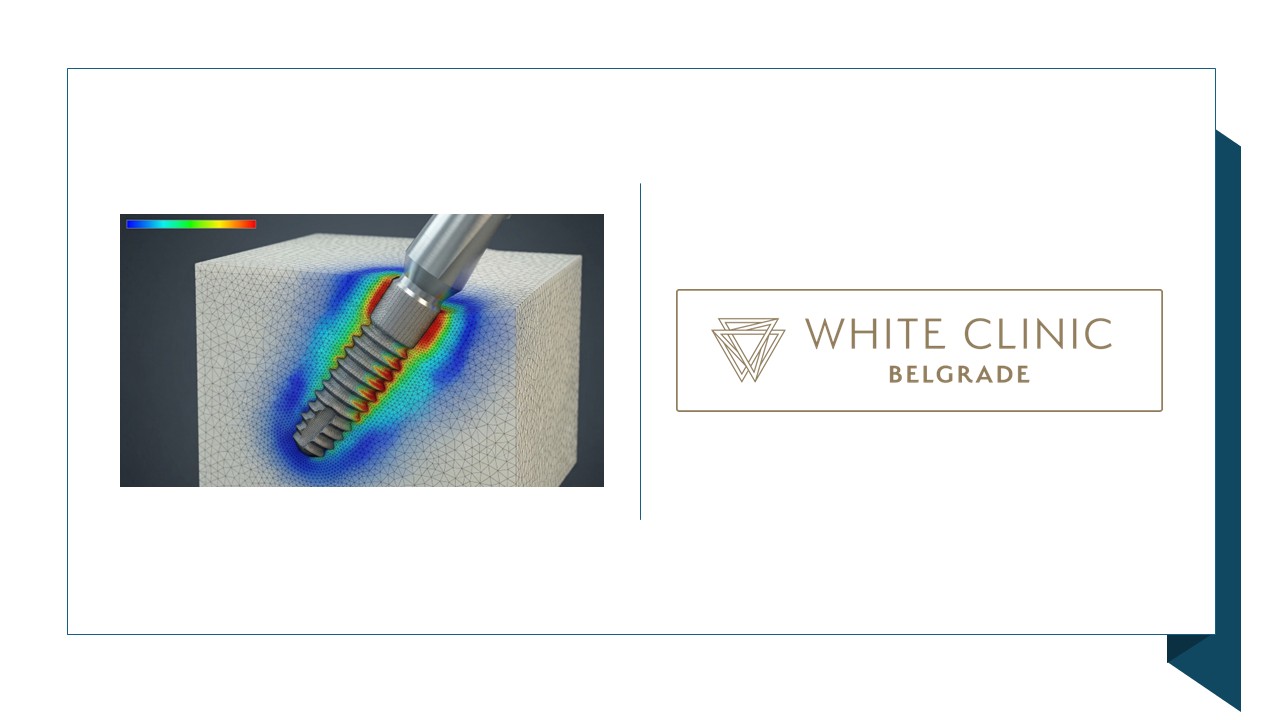
Increasing the AP spread reduces the load lever on the distal segments of the bridge. This, in turn, reduces the bending moments and stresses acting on the implants and prosthetic components. Finite element analysis (FEM) has demonstrated that tilted distal implants can contribute to a more favorable stress distribution compared to axially placed implants with a larger cantilever. It is important to emphasize that the biomechanical behavior of the system cannot be assessed based on the implant angle alone, but rather as a result of the interaction between angulation, implant length, bone quality, superstructure rigidity, and occlusal design.
Prosthetic Aspect and Passive Fit
From a prosthetic perspective, tilted implants require the use of angled abutments (multi-unit abutments), which achieve:
- Correction of the insertion path.
- Parallelization of the supports.
- Passive fit of the framework.
- Reduction of stress in the screw connections.
Studies indicate that the passive fit of the framework is a more significant factor for the long-term stability of the system than the implant angulation itself. Inadequate fit can lead to micromovements, material fatigue, and complications such as screw loosening or fracture. Rigid, screw-retained frameworks with metal or titanium sub-structures show more favourable biomechanical behavior compared to less rigid systems.
Loading and Force Transmission
In the All-on-4 concept, the load is transmitted through:
- Axial forces.
- Lateral (transverse) forces.
- Torsional components.
Experimental and numerical studies have shown that tilted implants do not significantly increase axial stress in the peri-implant bone when the prosthetic cantilever is controlled. Conversely, shortening the cantilever has a greater impact on reducing stress than the potentially negative effect of the angulation itself. The length of the cantilever should be proportional to the AP spread. It is recommended that the cantilever does not exceed 1.5–2 times the AP distance between the most anterior and most posterior implants.
Lateral Forces and Occlusal Concept
Lateral forces have a higher potential for causing unfavourable stress compared to axial forces. Their effect is more pronounced in cases of:
- Long cantilevers.
- Inconsistent occlusion.
- Parafunctional habits.
- Inadequate distribution of occlusal contacts.
Prosthetic strategies for reducing lateral forces include:
- Group function or controlled occlusion.
- Reduction of cusp inclination.
- Narrowing the occlusal table.
- Avoiding heavy contacts on the distal segments.
- Careful balancing in eccentric movements.
Biomechanical analyses show that lateral forces generate higher bending moments in the implant neck area, but a rigid, cross-splinted framework significantly reduces the individual load on each implant.
Conclusion
The angulation of distal implants in the All-on-4 concept represents a biomechanically and prosthetically justified therapeutic strategy. From a prosthetic standpoint, the key factors for long-term success are not only the implant angle but the overall design of the system—passive fit, superstructure rigidity, cantilever control, and a properly defined occlusal surface. When these parameters are adequately planned, lateral forces and bending moments can be effectively controlled, leading to a predictable clinical outcome.
Literature
- Malo P, Rangert B, Nobre M. All-on-4 immediate-function concept with Brånemark System implants for completely edentulous mandibles: a retrospective clinical study. Clin Implant Dent Relat Res. 2003;5(Suppl 1):2–9.
- Malo P, de Araújo Nobre M, Lopes A. The use of computer-guided flapless implant surgery and four implants placed in immediate function to support a fixed denture: preliminary results after a mean follow-up period of thirteen months. J Prosthet Dent. 2007;97(6 Suppl):S26–S34.
- Krekmanov L, Kahn M, Rangert B, Lindström H. Tilting of posterior mandibular and maxillary implants for improved prosthesis support. Int J Oral Maxillofac Implants. 2000;15(3):405–414.
- Bevilacqua M, Tealdo T, Pera F, Menini M, Mossolov A, Drago C, Pera P. Three-dimensional finite element analysis of load transmission using different implant inclinations and cantilever lengths. Int J Prosthodont.2008;21(6):539–542.
- Bellini CM, Romeo D, Galbusera F, et al. A finite element analysis of tilted versus nontilted implant configurations in the edentulous maxilla. Int J Prosthodont. 2009;22(2):155–157.
- Zampelis A, Rangert B, Heijl L. Tilting of splinted implants for improved prosthodontic support: a two-dimensional finite element analysis. J Prosthet Dent. 2007;97(6 Suppl):S35–S43.
- Sannino G, Barlattani A. Mechanical behavior of angled abutments: a three-dimensional finite element analysis. Int J Oral Maxillofac Implants. 2013;28(3):e14–e23.
- Aparicio C, Perales P, Rangert B. Tilted implants as an alternative to maxillary sinus grafting: a clinical, radiologic, and periotest study. Clin Implant Dent Relat Res. 2001;3(1):39–49.


Leave a Reply