

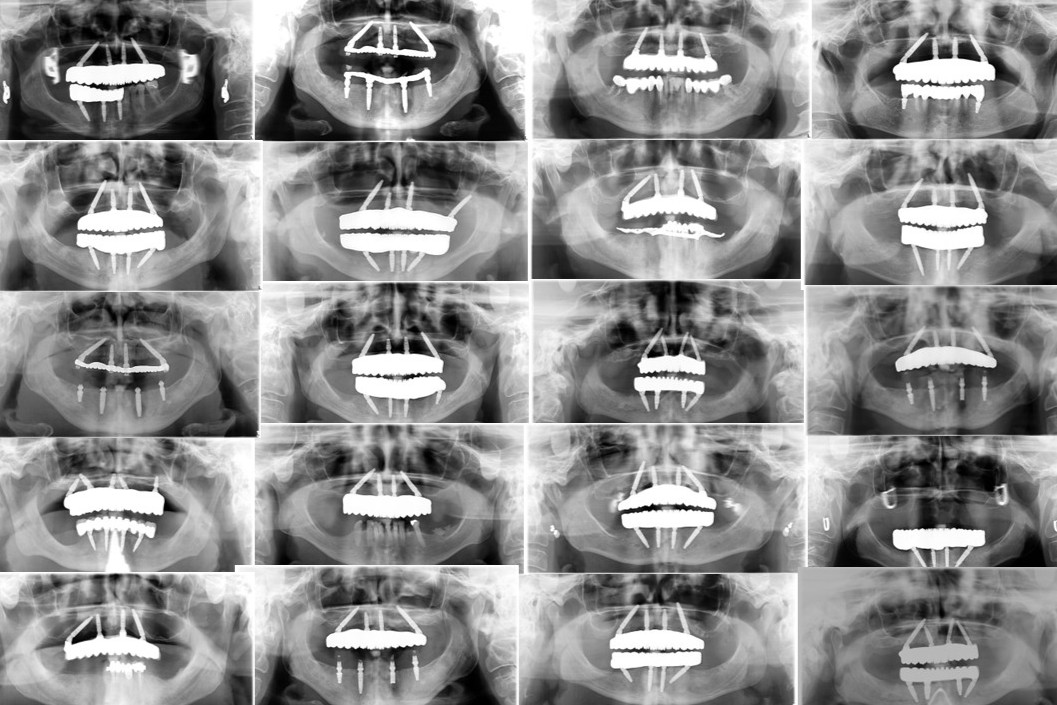
The evolution of full-arch rehabilitation has transitioned from “The more, the merrier” approach of the 1990s and early 2000s to the sophisticated biomechanics of the Graft Free Implantology movement.
Historically, treating implants as direct analogs for natural roots led to catastrophic failures. High implant density compromised blood supply and violated the necessary 3mm biological width between fixtures, resulting in peri-implantitis and crestal bone resorption (1). The subsequent reliance on Guided Bone Regeneration (GBR) and vertical augmentation introduced unnecessary morbidity, cost, and unpredictability into our practices.
The Malo Legacy and Cortical Engagement
The “All-on-4” protocol was never just about the number four; it was a shift in surgical philosophy. By utilizing tilted posterior implants, we:
- Increase the AP Spread: Optimizing the prosthetic base reducing the distal cantilevers.
- Engage Cortical Bone: Utilizing the dense maxillary and mandibular cortex for primary stability (over 35 Ncm), enabling immediate loading (2).
- Bypass Sinus/Nerve Anatomy: Eliminating the need for invasive grafting procedures.
- Protect all implants with Provisional teeth by splinting: Splinted implants act more as one unit and the BIC (Bone to Implant Contact) is increased, thus reducing individual implant failures (3).
Defining the Hybrid Protocol
Today, the terms “All-on-6” and “All-on-X” may have little to do with the original protocol. A true “All on 4” approach as part of the Graft Free concept isn’t defined by the quantity of titanium, but by the adherence to four pillars: Immediacy, Cortical Anchorage, Soft Tissue and Esthetic Considerations. While Dr. Paolo Malo pioneered and perfected the original All-on-4® protocols, the field continues to advance through meaningful modifications by practitioners who master its core principles; it is this capacity for evolution that proves the protocol’s enduring strength and clinical validity
Even though 4 implants are biologically sufficient for most arches, the anatomy may dictate 5, 6, or even 7 to achieve the necessary torque and reduce cantilevers. However, long-term data confirms that when protocol is followed, there is no statistically significant difference in survival rates between arches supported by four implants versus those supported by six (4). Increasing the sheer number of implants should never be a substitute for poor placement or a lack of cortical engagement. True success in full-arch restoration lies in the strategic distribution of forces and the preservation of native bone—not in the number of fixtures on a surgical tray.
- Tarnow DP, Cho SC, Wallace SS. The effect of inter-implant distance on the height of inter-implant bone crest. Journal of Periodontology. 2000;71(4):546-549. (This is the definitive study proving that implants closer than 3mm lead to significantly higher bone loss).
- Malo P, de Araújo Nobre M, Lopes A, et al. “All-on-4” immediate-function concept for completely edentulous maxillae: A clinical study. Clinical Implant Dentistry and Related Research. 2012;14:s139-s150. (Supports the philosophy of tilted implants and cortical engagement).
- Brunski JB. Biomechanical factors affecting the bone-implant interface. Review of Biomedical Engineering. 1992;20(1):153-187. (Supports the “splinting” concept and force distribution).
- Polido WD, et al. Number of implants placed for complete-arch fixed prostheses: A systematic review and meta-analysis. International Journal of Oral & Maxillofacial Implants. 2018;33. (Proves that adding more than 4 implants doesn’t necessarily increase the success rate).



Leave a Reply